
"Astro" by Paul Van Hoeydonck
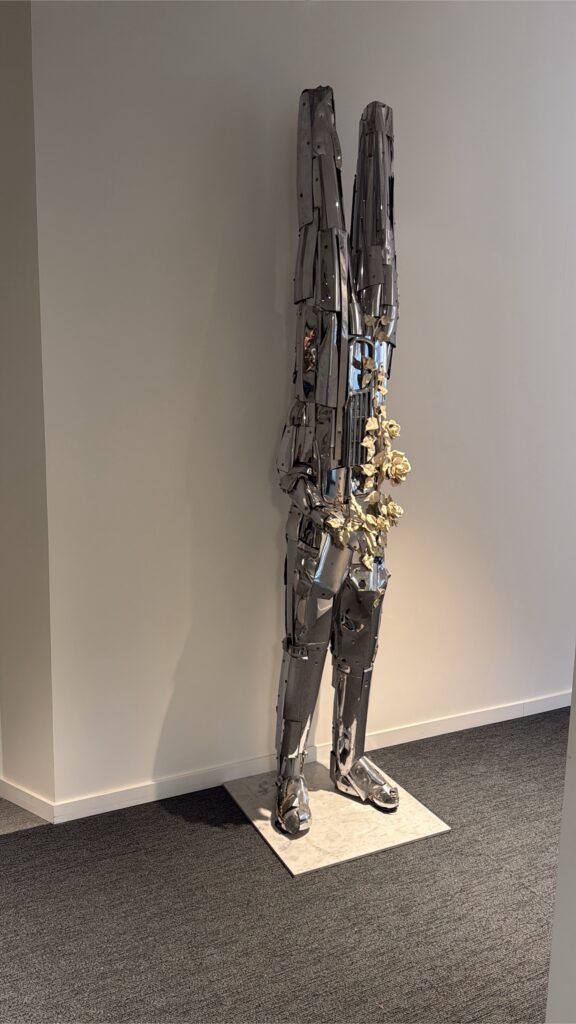
Paul Van Hoeydonck (October 8, 1925 – May 3, 2025) was a versatile Belgian artist: sculptor, painter, draughtsman, collage artist and graphic designer. As a modern sculptor, he worked with contemporary materials such as bronze, chromed steel, Plexiglas, polyester and “mixed media”.
However, he is best known for his “Fallen Astronaut” sculpture, left on the Moon by the Apollo 15 astronauts in 1971 as a tribute to their lost colleagues. At the time, it was the only work of art on our natural satellite, until 125 mini-sculptures by American artist Jeff Koons landed on the Moon in February 2025.
This essay tells the story of the artist Paul Van Hoeydonck between 1955 and 1965, his links with art dealers such as Iris Clert, critics like Jan Walraevens and Pierre Restany, and art cities such as Brussels, Antwerp, Paris, Venice, Milan, Düsseldorf and others.
BRUSSELS
Van Hoeydonck’s short period of geometric abstraction began around 1955 with art movements such as “ArtAbstrait”, “Formes” and “Art Construct”. In 1957, he produced his first monochrome collages with slices glued and overpainted on canvas.
In 1956, 1957 and 1959, Galerie Saint-Laurent exhibited his reliefs, drawings and paintings.
Paintings, followed by solo exhibitions at the Palais de Beaux-Arts with “plexi-reliefs with light work“and “cities of the future“. He abandons the flat surface and begins to dematerialize his work by manipulating light and shadow.
In 1961, he exhibited his “Bonhommes et monocles de PVH – peintre du ciel“at the Galerie P. Vanderborght, accompanied by the publication of a manifesto by the important art critic Jan Walraevens.
In 1965, he was selected by Jean Dypréau and Pierre Restany to be part of the famous group “Pop Art, Nieuw Realism“at the Palais des Beaux-Arts.
ANTWERP
In the late fifties, Antwerp was a center for literature, theater, jazz and art. PVH joins the ” Forms“At the galleryAccent“. A number of Antwerp artists create “G58-Hessenhuis“and Antwerp briefly becomes the center of contemporary art in Belgium.
With Paul Ausloos (photographer), Jozef Peeters and Georges Vantongerloo (abstract artists), PVH takes part in a G-58 exhibition at Middelheim Castle.
Between 1958 and 1962, his works were exhibited several times at the Hessenhuis.
As co-founder, he took part in the G-58 group’s first exhibition in November ’58 with Vic Gentils, Pol Mara and Dan Van Severer.
He is selected for thePrijs Jorge belgische Schilderkunst“in 1958.
March 1959 marked the start of the major international exhibition “Vision in Motion – Motion in Vision”.Vision in Motion – Motion in Vision“He co-organized and exhibited with Robert Breer, Pol Bury, Yves Klein, Heinz Mack, Enzo Mari, Bruno Munari, Otto Mari, Otto Piene, Dieter Rot, Jesus Raphael Soto, Daniel Spoerri and Jean Tinguely.
In the same year, he produced his first monochrome reliefs in Plexiglas.
In October 1959, PVH presented a solo exhibition at the Hessenhuis. He befriended Georges Vantongerloo, and in November 59, he took part in the ” Tweede
Groepstentoonstelling G58 -Hessenhuis“with the same artists and the young Camiel
Van Breedam. In March 1960, he was again selected for the ” Prijs Jorge Belgische
Schilderkunst 1959“and received a nomination together with Bert De Leeuw and Walter
Vanermen.
In October, theDerde Groepstentoonstelling G – 58 Hessenhuis“is presented
without Vic Gentils who moved to the “Nieuwe Vlaamse School“built by Jef
Verheyen.
In January 61, PVH was second prizewinner at the 1960 Talensprijs, and in February 1961, it won the “Talensprijs”…..
In March 1962, he took part in the major “Anti-Peinture” exhibition with the “Troupe de Recherche d’Art Visuel (GRAN)” and Maurice De Clerq, Herman De Clerq, Herman De Vries, Eric Dietman, Wybrand Ganzevoort, Karl Gerstner, Herman Goepfert, Jan Henderikse, Jochen Hiltmann, Walter Leblanc, Piero Manzoni, Christian Megert, Henk Peeters, Martial Raysse, Jan Schoonhoven, Gruppo N (Padua) and Gruppo T (Milan). This exhibition was not anti-painting, but an attempt to broaden its boundaries.
After 1962, Ghent took over from Antwerp as a center for contemporary art. In Ghent, PVH contributes to the Forum exhibitions.
In Ghent, PVH takes part in the Forum exhibitions. At the 1963 Forum exhibition, PVH shows its “Cosmologisch Interplanetair”.
PARIS
In the Fifties, Paris was the center of art, with the Nouvelle Vague in cinema, the Nouveau Roman in literature… It was in this war zone that Iris Clert set up her gallery.
Her gallery with famous artists such as Yves Klein, Lucio Fontana, Jean Tinguely, Arman and Takis. Belgian collector Philippe Dotremont advises Iris Clert to invite PVH to her new gallery at 28, Faubourg Saint-Honoré at the end of ’61. PVH presented large white panels with subtle variations in color, uncluttered and open to space.
This exhibition, entitledSpaces of Silence“was a great success, and Iris Clert managed to sell a painting to the New York Museum of Modern Art.
In spring 1963, PVH took part in the exhibition “Grande Quinzaine Fiscale – Salon d’Avril. L’An 2104 présenté par 40 artistes”, with Arp, Arman, Bury, Chaissac, Copley, Fautrier,Fontana, Labisse, Man Ray, Seuphor and Takis.
During this period, PVH struck up a friendship with the famous art critic Pierre Restany, founder in 1960 of the “Nouveau Réalisme” group (Yves Klein, Arman, Christo, Cesar, etc.). PVH was never a member of this group, but evolved towards assemblage art and exhibited at Galerie Clert with “Space-Boys“decapitated mannequins from another galaxy.
VENICE-MILAN
Antwerp and Paris took PVH to Milan and Venice, where he made friends with Lucio Fontana and Piero Manzoni, often seen in Antwerp.
With constructivist Guy Vandenbranden, PVH began exhibiting in 1959 in the same gallery as Jef Verheyen: “Pater” in Milan.
In the summer of 1962, PVH is one of the guests of honor at the XXXI Venice Biennale, where he exhibits 5 white works. Iris Clert organizes an exhibition with Fontana, Pol Bury and Takis at her “Piccola Bienale” in Palazzo Papadopoli.
A gigantic space construction was on display, a work that stunned the crowd and showed that the old and the new can come together.
Time and Life magazines published an article on the exhibition, which welcomed 3,000 visitors, including Peggy Guggenheim. In 1964, Iris Clert returned to the Venice Biennale, presenting her artists on a boat, the “Biennale Flottante” with PVH and oval paintings by Fontana.
At the same time, PVH exhibited at the Del Leone Gallery in Venice.
That same year, Guido Le Nocci invited him to Milan to visit the Galleria Apollinaire, where Yves Klein had begun working.
The same year, he was invited by Guido Le Nocci to Milan, to the Galleria Apollinaire, where Yves Klein began his blue period.
DUSSELDORF-GERMANY-HOLLAND
Düsseldorf is the birthplace of the ZERO Group, with founders Heinz Mack, Otto Piene and Göteborg.
PVH was never a member of ZERO, but participated in several major exhibitions in Germany and the Netherlands. Starting from nothing, these artists wanted to create a new art by analyzing light, space and time. In March 1960, PVH was invited to the exhibition.
In March 1960, PVH was invited to the Städtliches Museum Schloss Morsbroich in Leverkusen to take part in an exhibition with Lucio Fontana, Piero Manzoni, Yves Klein, Jef Verheyen, Paul van Hoeydonck and other artists.
In 1961, he took part in the “ZERO-edition, Exposition.
In 1964, PVH received an invitation to Documents III in Kassel, where the object was represented by artists such as Kurt Schwitters, Zoltan Kemeny, Pomodoro, Vic Gentils, Pol Bury, Louise Nevelson and Joseph Beuys.
Holland played an important role in the ZERO movement with the very active NUL movement.
In The Hague, PVH exhibited at the Orez gallery in January 1962 in the “Nieuwe Tendenzen” show with Armando, Fontana, Henderikse, Yves Klein, Heinz Mack, Piero Manzoni, Otto Piene and Günther Uecker.
In 1962, an exhibition entitled “Nieuwe Tendenzen” opened at Leiden’s Rijksuniversiteit.
In 1964, the “Nieuwe Realisten” exhibition at The Hague’s Gemeentemuseum brought PVH’s work face to face with that of major international artists.
NEW YORK-USA
PVH became world-famous at the Sao Paolo Biennale in 1961.
From the mid-sixties, he became active in the United States, participating in the “White on white” exhibition at the Lincoln De Cordova Museum with Malevitch, Albers, Arp, Fontana, Piene and Uecker. Harald Szeeman exhibited the same “Weiss auf weiss” in modified form at the Kunsthalle Bern in May 1966 with PVH, Pol Bury, Lucio Fontana, Piero Manzoni, Robert Rauschenberg, Georges Segal and Victor Vasarely.
Through the intermediary of Antwerp and New York lawyer Harry Torczyner, PVH meets important artists, gallerists, curators and other art world personalities.
A few years later, in 1971, the astronauts of the Apollo 15 spacecraft placed one of his sculptures on the moon.
In the past, artists gathered in picturesque locations such as Barbizon, The Hague and Sint-Martin’s-Lathem. PVH was part of the first post-war generation of modern artists, who traveled and communicated easily to seek out artists all over the world.
Light and white on white, which refer to space, are particularly important in his work.
More than his own form, color and materials, it was the accentuation of the human being in space that enabled him to be ahead of his time, like his colleagues and friends Fontana, Manzoni, Yves Klein and Jef Verheyen,
PVH is educated in philosophy and the history of philosophical and historical art. He has also written articles and essays outlining his vision of man and space.
From 1955 to 1965, he was a protagonist on the European scene, not only to radically renew, but also to use tradition for the personal development of his art.
Yves Klein was delighted when Gagarin spoke of the beauty of the color blue in space. Lucio Fontana, declared that it was he who had opened the space by cutting the canvas, but that it was PVH who had made it burst.
Essay by Ernest Van Buynder – Chairman Antwerp Museum of Contemporary Art – (MuHKA) July 2008